Tuesday, June 14, 2011

Grand Prix du Canada, done right.

The past weekend marked the only North American stop on the Formula 1 calendar - until 2012 at least - held at Circuit Gilles Villeneuve in Montreal, Quebec. The circuit skirts tiny Île Notre-Dame and features some famous corners, including a hairpin and one named after racing deity Ayrton Senna. The course is a driver's favorite although this year's GP may have temporarily spoiled that sentiment, due to an unprecedented 2-hour rain delay. Quick recap: Mercedes Mclaren's Jenson Button stole what would have been another victory for Vettel, in lap 70. Out of 70! Button deserves the credit though, working his way from dead last at one point, making up for many pit stops, a tussle with team mate Lewis Hamilton, a speeding violation (they have those), weather etc. Also of note, is a 4th place finish from Shumacher, who is on the rise in his second season back from retirement. Hamilton, who has been successful here historically, was forced to retire. Kinda had that coming to him. Anyways, the point of this post is to shed some light on what to expect at a GP and how to do it right, and cost effectively.


Tip number one on the weekend: Do NOT plan a trip last minute. I decided to go to the Canadian Grand Prix just two days before the event. I had an amazing time, and being spontaneous is fun, however, you can save a lot of money if you book in advance. Fortunately I was able to cash in on some frequent flyer points, and didn't pay a cent for lodging. Had it not been for this though, the only hotel less than $100/night was 40 miles away from the race. The city takes the GP very seriously and staying downtown becomes a $500/night affair. Hostels are in the range of $30/night and a good option if you are traveling in a group, but they're almost exclusively 3-night minimum rental, so plan for that. Definitely book on Expedia and maybe they'll mess up and give a free upgrade to here...

Second: Buy general admission tickets. Well sure, if you have the money buy grandstand seats, over by Virage Senna being the best to watch overtaking. For the rest of us, a 3-day GA pass costs $110, which is cheaper than a single day in the stands. You will have to get to the track early to secure an un-obscured spot on the infield, but it will be worth it -there are other races while you wait. If you heed the advice from tip two then you will also need to follow tip 2a: BUY EARPLUGS. We sat about 15 feet from the cars mid-straight and I thought my ears were going to bleed.

Number three: BYOR (bring your own radio). Being at a Formula 1 race is kind of like observing a golf tournament from the 9th hole. Unless you can cover a lot of ground really quickly (~200mph), or are willing to shell out hundreds for seats you will have no idea what's going on. Alternatively you can camp out by a screen but you will be hard-pressed to do so unless you get there seriously early. No matter what time you arrive, you will be able to see the action, though. The earlier the less likely you will be looking through a tree.

Final tip: Pick your transportation wisely. Having a car is essentially useless because there is nowhere to park and there is a metro stop which lets you out right at the front gates of the track. I say this with somewhat of a bias after my car suffered a freak break-down, costing me a couple thousand dollars more than I had planned to spend in one weekend. Even still, there are metro stops scattered all around town and buses to take you to the stations, if you can catch them. Busing up is definitely the most reasonable way to go, $75 one-way from Boston at least, which is currently what you would pay in gas anyways.

Even if you do not follow Formula 1 going to a race is an incredible experience. The sounds of howling V8s revving to 18,000rpm and the brutal shotgun-esque downshifts alone are worth the price of admission. It truly is a symphony but watching the race unfold you realize that this sport does not exist solely for our entertainment. It is a business and a showcase of modern engineering for the companies who sponsor the teams. The cars have presence, they command your respect. Watching the drivers chase down the car in front of them is like watching a really loud game of chess. As was the case with Sebastian Vettel the simplest mental error can lose you a race. The Montreal atmosphere is great too, the locals get really into it and appreciate every ounce of heroic late-braking and high-speed overtaking. I highly recommend the Canadian Grand Prix to anyone and will certainly be back next year, definitely smarter, hopefully dryer.

Saturday, May 28, 2011

gMeter: l'introduction

Preface: As mentioned in the previous post I hit some car trouble in Canada. Actually I had an engine swap, so it's more like a major problem. Between fatigue, sorting that out, and another project in collaboration with ma man Shane, this project is off to a slow and undocumented beginning. To that end, here is an intro while I chip away at the project.

For the longest time I've been interested in doing something with inertial sensors. It's no secret that I am also a car-obsessive, so the logical starting point was to create a g-meter for my car. Does it tell you how "G" or ghetto someone/thing is? No, but later versions may feature a cockometer setting to tell you "how much of a cock you look." Of course, a g-meter measures the lateral cornering force of your car, typically in units of gravities. As a basic reference an average street car can handle just under one gravity, and a formula one car will stay planted while pulling nearly five g's! "How many can the Volvo manage?" I wondered. Time to find out.

Image courtesy of TheEngineersCorner.

The most critical component of this project would be the accelerometer, for which I chose the tried and true 3-axis ADXL335, yours with breakout board for $24. Having no prior experience with accelerometers and no qualitative evidence for comparison I think this is a great sensor. I used it as it came, with 0.1uF decoupling capacitors which restrict the bandwidth to 50Hz. Choosing the bandwidth is a compromise between noise and resolution and the stock setup proved a good balance thus far.

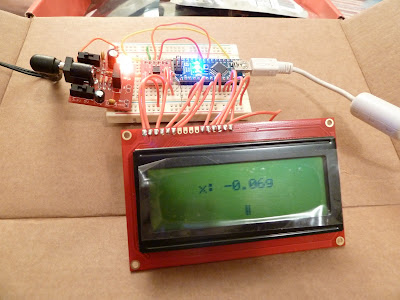
For starters the sensor needed to be calibrated by picking an accurate scaling factor. This is a number in units mV/g which converts the output signal from volts to gravities. The ADXL335 is ratiometric so the data sheet provides experimental values for the scaling factor at the max and min supply voltages. Running the sensor off a 3.3V line I needed to determine the SF in between the given values, which meant linear interpolation. Not the best since clearly the response is not linear, but close enough. To confirm this I devised a shotty test by taping a breadboard with the accelerometer and an Arduino to my dash as a brave friend riding shotgun read the x (lateral axis) outputs off my laptop in realtime. Meanwhile, another friend monitored readings from a free app on my phone and I drove fast (safely, Mom) down a windy road. The results were reasonable, achieving a max of about 0.74g on a particularly tight bend. During this test power was being supplied via USB so I will need to tweak the SF once the power source is finalized, probably a small 2S LiPo.

Quick and dirty g-meter.

This all came together frighteningly quickly. I added an lcd to the mix but even that has a very common HD44780 chipset and pre-made Arduino library of course. I did not like this, and I started to feel guilty about all this Arduino business. Using them is kind of like admitting that you like Britney Spears music...or something. It's just not hardcore. Arduino's are great tools and by no means have I come close to mastering all of their capabilities, but building things shouldn't be like one of those snap-together model airplanes. So instead of soldering what I had together and stuffing it all into a box, it was time to take the project down a windier and potentially bumpy path.

If we're going to dabble in such terrible things as software, then we ought to at least do it right. Enter the AVR ATtiny2313, a very popular microcontroller for small custom applications like this, and most importantly, no Arduino bootloader! In fact, that is the last time I will use the "A-word" in this post. It feels liberating now but pretty soon I'm sure I will begin kicking myself. I bought an AVR ISP II and put together a little target board. In the next few weeks I will work on the software, anticipating that the lcd will probably be the hardest part. No turning back now.

Unnecessary switch, led, and cap. Why not.

After the recent car bill I need to be thriftier than ever. For the circuitry I won't be ordering a shiny new PCB, instead I am researching the process of etching one myself. Failing that look for a perfboard from Radio Shack with a lot of wires. Mechanically, all I can say is I've ordered some 1/16" sheet aluminum...

Monday, May 16, 2011

< Summer Projects >

While studying for finals I realized something, and that is procrastination, NOT necessity, is the mother of invention. With the dark cloud of exams looming overhead my mind naturally started generating ideas for the more exciting ways I could be spending my time. Now that they are over* my ideas are rapidly coming into fruition.

Motors Controllers:

After working with servo's for far too long, I bought some TI SN754410 quad half H-bridges and Sparkfun's cheapest motor, which turned out to also be their smallest! I wrote a quick Arduino/Processing sketch and touchOSC layout to integrate my iPhone control process to this tiny motor. It's very straight-forward, just PWMing the enable pin to control the speed. This was a success.


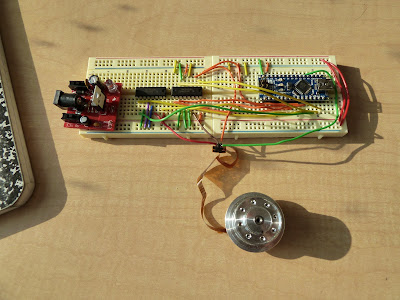
More recently, a friend handed me a hard drive spindle motor after realizing that a battery and wires alone could not bring it to life. It even has four wires, "what could the extra two do?" he might have asked. I knew it must be brushless and after a little bit of research, it turns out it's a 3-phase BLDC. There is one wire for each phase and the fourth is common. In a trial by fire effort I am in the process of building a controller with some parts I had lying around.


The basic idea is to drive each of the phases with one side with one, or one half-bridge. Thus two SN754410s are used. The Arduino Nano provides the PWMing for the three enable pins, the inputs for the six logic pins, and the back-EMF sensing. The latter will be the tricky part, and I am still doing some reading to determine the best way to do that -both in hardware and software. This is a sensorless motor, meaning instead of onboard hall-effect sensors the position of the rotor is approximated by detecting the back-EMF. Not any easy undertaking, and for now just a clusterfuck of wires.

In the background -or maybe the foreground- another project is in the making. Today I ordered a 3-axis accelerometer and a 20x4 LCD. I've had an itch to start working with inertial sensors for some time and I think I've found the perfect application. Hmm what could those be for? Hint: my car.

*one non-engineering final left

Thursday, April 7, 2011

Something Different

There's more to life than building things. Please enjoy this semi-serious cover of John Lennon's Imagine with my friend Seti on vocals and me with the keys.

Thursday, February 24, 2011

TOBL: It's Working.

It's working, it's working. It = TOBL and here are some stats:
  • 6 wheels
  • 18 gears (think about it...)
  • 84 oz/in Torque
  • iPhone-controlled via TouchOSC app interface
  • OSC/Serial communication
  • 8 zip-ties
  • Top speed of 0.413 mph (my personal favorite)
After much adieu, TOBL has been captured on film with my new camera -a Pansonic Lumix DMC-ZS7. It's about to make this blog a whole mess snazzier, 9.1 megapixels more snazzy to be exact. Henceforth, all videos shall be shot in 720p HD, like this one (fast-forward to 2:34 for wall flips):

Kind of dark but I still recommend watching in 720p.

Now held together by 8 zip-ties, thats 4X as strong as last time!

One of the finishing touches on TOBL was trimming the servos. However, PWMShield V1.0 is not yet wirelessly-updateable and in the monotony of disconnecting and reconnecting all the controls hardware, I vaporized yet another trace. This board should be renamed "GhettoShield" after all the loose wires I've had to solder to busted traces. The circuit works fine though, and using it saves $33. After fixing the trace the servos were trimmed.

Can you spot the latest exo-trace?

I don't talk about software very often, and that's because I don't know much about it. I do like to share the code I use though, isn't that the point of the whole open-source movement? After all, most of the communication software for TOBL was "taken" from this iPhone-controlled tank and this SFE tutorial (Thanks to both!). I modified bits of this software and wrote the rest to interface this existing code with my TouchOSC layout and electronics. In order to return the favor here is the Arduino and Processing code. You'd think a wireless iPhone-controlled robot would have denser code than ardWINDo, but take a look, it's surprisingly compact.

This project was a lot of fun. It's rare that you can take an idea and bring it into fruition exactly the way you imagined it. My initial goals were to make it iPhone-controlled and able to drive after rolling over -TOBL does both of those things. It wasn't cheap, I would estimate ~$250 including redundancies, but TOBL is an awesomely fun desk toy and an even better platform for playing with software, different sensors, and whatever else.

I also learned that servos are great for being servos, but not so great at being drive motors (especially modified micro-servos). For future projects I will venture down the new and exciting road of custom motor-controllers. Time to start playing with H-bridges...

Wednesday, February 2, 2011

TOBL: Testing

Done with my first exam of the semester and feeling like it's time to get back to TOBL, however briefly. I still don't have a camera to record test footage but that may change soon. Until then, here is the little guy in his most primitive form a.k.a. being held together by two whole zip-ties.

Yup, two.

So far testing has been limited to some laps around the apartment, during which I have already broken yet another spline gear. Reassembling the HS-81 plastic gear servos has worked out well. One of the wheel gears was a little tight, but has since been fixed. So now the plastic gears should last longer than 10 minutes.

Since the servos were modified they don't center very well. I suspect this is because the resistors that replaced the potentiometer do not match exactly. However, I did trim them in software and even after wearing the battery down a bit the neutral point doesn't drift much. As often as I ramble about servos I've learned my lesson and my future projects will likely use motors, for drive purposes at least.

Speaking of future projects, my V1.1 XPWMShields are finally in. Somehow they were delivered twice? Go figure. I think the perfectly good V1.0 board will remain on TOBL as not to have wasted $33 and shipping. I'll be able to comment more on the functionality (namely wireless uploading!) once I get some new Nanos to test them.


On a side note, I've recently started working at the Micro Robotics Research Lab. I thought I was into making things on a small scale...not even close! This lab concentrates on MEMS, fabrication techniques, and small scale robotics in general. For example, one team is designing a similar wireless communications board to XPWMShield, except that the board is approximately 1cmx1cm! Very cool stuff. Technically I'm working there for a program I'm in, but we'll see what happens. As for TOBL I will try to acquire a camera asafp!

Saturday, January 29, 2011

XPWMShield V1.1: ...??

According to UPS tracking my Advanced Circuits order was delivered yesterday at 12:47pm and signed by a fellow named "WILSON." It's true, I could see the truck out my window! Regrettably, somewhere along the 100ft path from that truck to the front desk of South Campus Commons 1, the package was vaporized. It was never logged and nobody knows where it is. All I can say now is WIILLLSSSOOOOOOOOOOOOOOONNNNN!! And some four letter words which I already shared with the elevator and don't need to be shared here. I'll wait a few days before re-ordering, ugh.